
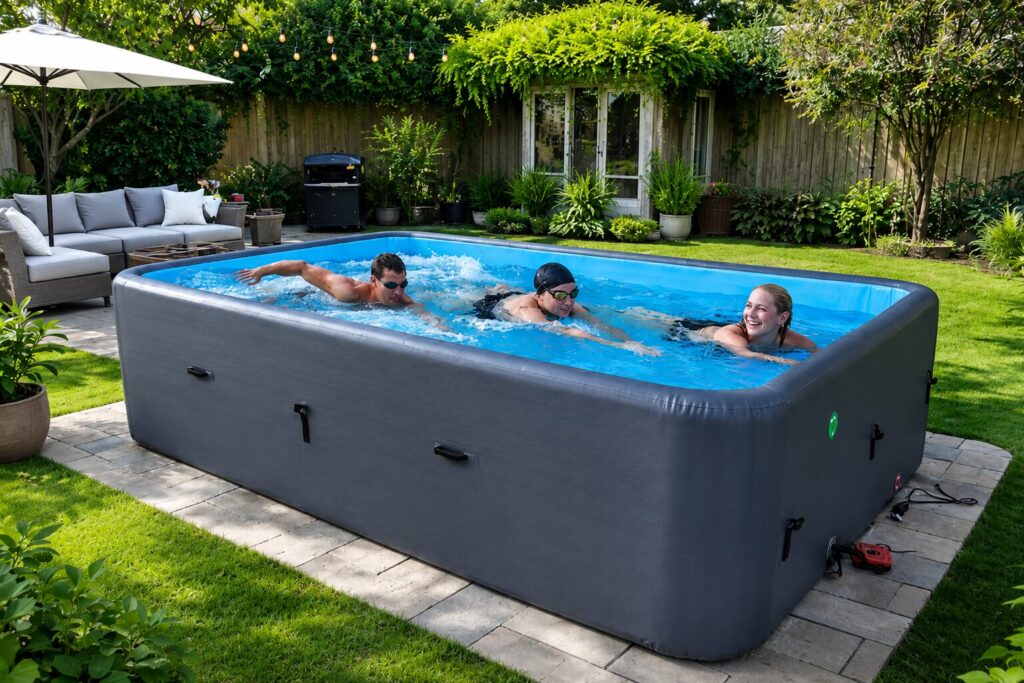
Drop Stitch vs Traditional PVC Inflatable Pools
Factory-Direct Wholesale & Custom Dimensions for Global Commercial Buyers.
Drop Stitch vs Traditional PVC Inflatable Pools: Which Is Better?
Whether you’re looking for a commercial floating pool, yacht pool, training pool, or custom inflatable swimming pool, choosing the right construction material is one of the most important decisions. Two of the most common options are Drop Stitch (DWF) and Traditional PVC Tarpaulin.
Although both are made from durable PVC materials, they are designed for different applications and offer different performance characteristics. Understanding the differences will help you choose the right inflatable pool for your business or project.
What Is a Drop Stitch (DWF) Inflatable Pool?


Drop Stitch, also known as Double Wall Fabric (DWF), is a premium inflatable construction technology.
Thousands of high-strength polyester threads connect the top and bottom PVC layers. When inflated to high pressure (typically 6–10 PSI), these threads keep the surfaces perfectly flat while creating an extremely rigid structure.
Instead of becoming rounded like a traditional inflatable, a Drop Stitch pool maintains straight walls and a flat floor, making it look and feel much more like a permanent swimming pool.
Key Features
- Flat, rigid walls
- High-pressure inflation (6–10 PSI)
- Excellent dimensional stability
- Professional appearance
- Comfortable walking surface
- Easy to fold and transport
What Is a Traditional PVC Inflatable Pool?


Traditional inflatable pools are manufactured from 0.9mm commercial-grade PVC tarpaulin using airtight welding technology.
Instead of internal threads, the pool walls are air chambers that become rounded when inflated.
These pools operate at much lower air pressure, usually around 2–3 PSI, making them softer and more flexible than Drop Stitch pools.
Traditional PVC inflatable pools are widely used for:
- Commercial water parks
- Floating pools
- Temporary swimming pools
- Event pools
- Promotional activities
Drop Stitch vs Traditional PVC Pool Comparison
| Feature | Drop Stitch Pool | Traditional PVC Pool |
|---|---|---|
| Construction | Double Wall Fabric (DWF) | Airtight PVC Air Chambers |
| Inflation Pressure | 6–10 PSI | 2–3 PSI |
| Wall Shape | Flat | Rounded |
| Rigidity | Very High | Medium |
| Floor Stability | Excellent | Good |
| Appearance | Premium & Modern | Traditional Inflatable |
| Weight | Lighter | Slightly Heavier |
| Portability | Excellent | Excellent |
| Comfort | Firm Surface | Softer Surface |
| Installation | Quick | Quick |
| Maintenance | Easy | Easy |
| Custom Shapes | Moderate | Excellent |
| Cost | Higher | More Economical |
Advantages of Drop Stitch Pools
1. Superior Structural Rigidity
Because the internal fibers prevent expansion, Drop Stitch pools remain extremely rigid after inflation.
The walls stay vertical, providing a cleaner appearance and better water containment.
2. Flat Walking Surface
One of the biggest advantages is the perfectly flat floor.
This provides:
- Better comfort
- Safer walking
- Easier cleaning
- Improved stability
3. Professional Appearance
Drop Stitch pools resemble permanent above-ground pools.
Their straight walls create a high-end appearance suitable for:
- Luxury resorts
- Hotels
- Yacht platforms
- VIP events
- Commercial exhibitions
4. Lightweight Design
Despite being rigid, DWF panels are relatively lightweight compared to heavy PVC air chambers.
This makes transportation and storage easier.
5. Excellent for Modular Designs
Drop Stitch panels can be manufactured with precise dimensions, making them ideal for:
- Rectangular pools
- Training pools
- Floating dock systems
- Yacht pools
- Modular water structures
Advantages of Traditional PVC Pools
1. Better Value for Large Projects
Traditional PVC inflatable pools are usually more cost-effective, especially for large commercial installations.
If budget is a priority, PVC pools offer excellent performance at a lower cost.
2. Highly Customizable
PVC welding technology allows manufacturers to create almost any shape, including:
- Circular pools
- Oval pools
- Custom logos
- Animal shapes
- Promotional pools
- Interactive water features
3. Excellent Durability
Commercial PVC tarpaulin is:
- UV resistant
- Waterproof
- Abrasion resistant
- Mold resistant
- Tear resistant
With proper maintenance, these pools can provide many years of commercial use.
4. Easier Repairs
If accidental damage occurs, PVC tarpaulin is simple to repair using professional PVC repair kits or heat welding.
Which Material Is More Durable?
Both materials are designed for commercial use and offer excellent durability.
Drop Stitch
- High resistance to deformation
- Excellent rigidity
- Resistant to bending
- Strong tensile strength
Traditional PVC
- Better impact absorption
- More flexible under heavy loads
- Excellent puncture resistance
- Proven long-term outdoor performance
For heavy commercial use, both materials can last 5–8 years or longer, depending on maintenance, climate, and operating conditions.
Which Pool Is Easier to Install?
Installation is quick for both designs.
The general installation process includes:
- Unfold the pool.
- Connect the air pump.
- Inflate the chambers.
- Inspect all valves.
- Fill with water.
- Begin operation.
Most commercial inflatable pools can be installed within 15–30 minutes.
Which Pool Is Better for Different Applications?
| Application | Recommended Material |
|---|---|
| Backyard Swimming Pool | Drop Stitch |
| Luxury Hotel Pool | Drop Stitch |
| Yacht Pool | Drop Stitch |
| Swimming Training Pool | Drop Stitch |
| Floating Dock Pool | Drop Stitch |
| Commercial Water Park | Traditional PVC |
| Rental Business | Traditional PVC |
| Event Pool | Traditional PVC |
| Promotional Pool | Traditional PVC |
| Custom-Shaped Pool | Traditional PVC |
Cost Comparison
Price varies depending on the pool size, design complexity, and accessories.
In general:
- Drop Stitch pools have a higher initial cost due to the advanced DWF construction and high-pressure manufacturing process.
- Traditional PVC pools are more budget-friendly, especially for large commercial projects requiring custom shapes or larger dimensions.
When evaluating cost, consider the pool’s intended use, expected lifespan, maintenance requirements, and customer experience rather than price alone.
How to Choose the Right Inflatable Pool
Choose a Drop Stitch pool if you need:
- Luxury appearance
- Flat rigid walls
- High-end resort use
- Yacht applications
- Swimming training
- Premium customer experience
Choose a Traditional PVC pool if you need:
- Lower investment
- Large commercial pools
- Custom designs
- Water park attractions
- Rental business equipment
- Flexible project layouts
Why Choose Hushine Inflatables?
Hushine Inflatables specializes in manufacturing commercial inflatable pools for water parks, resorts, hotels, marinas, yacht clubs, and event organizers worldwide.
We offer:
- Commercial-grade 0.9mm PVC Tarpaulin and Drop Stitch (DWF) construction
- Custom sizes and shapes
- UV-resistant, heat-welded, airtight designs
- Reinforced seams for long-term durability
- OEM & ODM manufacturing
- Global shipping and professional technical support
Whether you need a compact backyard pool, a floating yacht pool, or a fully customized commercial inflatable pool, our experienced team can provide a solution tailored to your project.
Frequently Asked Questions
Is Drop Stitch stronger than traditional PVC?
Drop Stitch provides greater rigidity and shape stability due to its internal fiber construction, while traditional PVC offers superior flexibility for large or custom-shaped inflatable structures. Both are highly durable when manufactured with commercial-grade materials.
Can Drop Stitch pools be used in saltwater?
Yes. Drop Stitch pools are suitable for both freshwater and saltwater environments. Rinsing the pool with fresh water after saltwater use helps extend its service life.
Which material is better for commercial use?
It depends on the application. Drop Stitch is ideal for premium pools, yacht platforms, and training facilities, while traditional PVC is often the better choice for commercial water parks, rental businesses, and large custom installations.
Are both materials UV resistant?
Yes. Commercial-grade PVC tarpaulin and Drop Stitch materials are treated to resist UV exposure, fading, and outdoor weather conditions.
Can I customize the size and color?
Absolutely. Both Drop Stitch and traditional PVC inflatable pools can be customized in terms of dimensions, colors, branding, and accessories to meet your specific project requirements.
Final Thoughts
Both Drop Stitch and Traditional PVC inflatable pools deliver reliable performance, but each excels in different situations. Drop Stitch offers a sleek, rigid, premium feel that is ideal for luxury applications, while traditional PVC provides exceptional versatility, affordability, and customization for commercial projects.
Before making your decision, consider your budget, intended use, desired appearance, and long-term operating needs. Choosing the right construction material will help maximize durability, user experience, and return on investment.